Monday, July 29, 2013

"O Romeo, Romeo, wherefore art thou to put the hoop house?"

Hoop house...high tunnel...cold frame..."What's in a name? That which we call a rose by any other name would smell as sweet".  
Shakespeare's Romeo said it well.
I am getting ready for adding one of these beauties to my farm through my local NRCS; Natural Resource Conservation Services of SC.  Every farmer can apply for a "free"one during their project timeline.  "Free" meaning, you buy it up front, then they reimburse you if you follow the practice guidelines for 3 years, and if they have the funds.  Still worth it, if you ask me.  It is a great way to lengthen your growing season in a controlled environment.  This is a national NRCS initiative.  I learned about it from someone's blog!  Where I live I may be able to put it to use all year round considering I had many plants winter over and survive.  The big question is, where to put it?

I have learned a thing or two this summer because it has been wet...no, let me rephrase...we have had torrential downpours about every few days, sometimes for days at a time.  The problem with living nearly at sea level is that the rainwater has no where to go.  I am told that my area of SC used to be ocean.  So, if I dig about 12-20" under the loamy sandy soil I find hard clay or basically really hard, packed sand.  Ocean is still here.


I always thought I could use my back 2 acres for farmland but have learned that it has the potential to stay very wet and drowned under about 6"of water, killing everything I plant there. My decision for hoop house placement has changed to a place much closer to the barn. 


Good decision, Juliet.  Good decision.

Friday, July 19, 2013

French blogs speak my language...

I love the visual inspiration of French blogs.  
They give me my daily "kick" along with my morning latte.  Some of my favorites are Chez Loulou, My French Country Home and French Basketeer.
If a picture is worth a thousand words, then these creative women are speaking the language that would inspire anybody.  Their perspective through their lens takes in the French countryside, Paris shops, freshly prepared food and stunning architecture.  They whisk me away to a mini vacation in Paris, Normandy or the south of France...in my mind's eye, of course.  I want to be there with them drinking wine in a French cafe or buying smelly cheese from the open air markets.  I am starting to feel like I know them as close friends.  That is the beauty of it all.
So, in like manner, I decided to cut short my words today and post some pictures of Le Farm
 to enjoy, be inspired, get whisked away to the south of carolina!
Enjoy!

Built in c. 1869...turquoise was my choice!
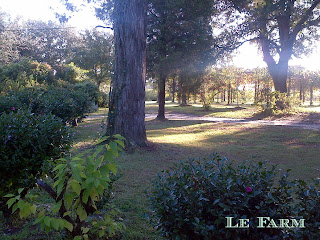
Morning light streaming across huge live oaks...
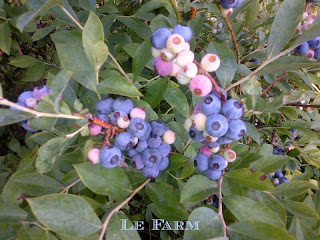
These are just some of my beautiful Rabbiteye variety of blueberries.


Adjoining cotton fields in the sunrise.
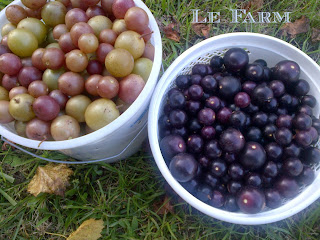
Delicious, huge and very sweet muscadine grapes. Some are the size of a plum!
Zinnias growing in the back field.
A great porch when it is pouring down rain.
I just love the louvered doors.
The center dressing room.  What a cool old transomed doorway.  Nothing is level and everything sort of rolls east!


Dining country french style.  (Yes, I painted the fireplace and my table...I am dangerous with a paintbrush in my hand!)


Huge windows provide a view of beautiful camellias just outside.
Very long and wide center hall in the "Little River style" architecture where all the rooms come off the center hallway.  I would have loved this as a kid...I'll race ya!
Guest room...blueberry blue! Come and stay a while.


Master bedroom. Almost all the rooms have fireplaces but none are operational.
In the foreground is a table made from old door I found in the barn.


Can you tell I love pale blues? So calming and peaceful.


The other end of the center hall.  It's a room in itself with original wide plank flooring.
My "French" foyer.
Living room in pale blue and chocolate brown with my Craigslist find of an ivory colored leather sofa.  I painted and distressed my old brown coffee tables and end tables ivory, too.


A full view of the master bedroom.  I had to custom make all my drapes over 100 inches long.


French roosters are a must in my country french kitchen.
As close to Paris as I can get...

Wednesday, July 17, 2013

Sir Isaac Newton and my pear tree...


"I do not know what I may appear to the world; but to myself I seem to have been only like a boy playing on the seashore, and diverting myself now and then in finding a smoother pebble or prettier shell than ordinary, while the great ocean of truth lay all undiscovered before me."   --Isaac Newton
I was on my riding mower and a low hanging pear clunked me in the head.  Up to that point the only thing on my mind was to get the big job finished before I was shut out by rain or darkness...had to stick to the schedule, or else.  The pear tree diverted my focus and reminded me of fall, my favorite time of the year, which comes on very slowly, leaf by falling leaf.  I looked down and saw the ground was littered with gorgeous chocolate brown pear leaves.  I love that beautiful effect.  Various shades of dark chocolate against the vibrant green lawn.  It is just as beautiful to me as New England's stunning display.
Sometimes the smallest things inspire me and renew hope that things are constantly changing, moving on in their own way. My thoughts were stuck in a cycle of thinking that I am extremely overwhelmed handling a farm by myself. (And this could be applied to anyone that feels overwhelmed by their situation.)
Truth be told, I actually am doing quite well, making much progress, not flailing or even just maintaining.  I was completely humbled when I saw a young woman motoring down the sidewalk in her wheelchair, recently.  How dare I even think that my life was anything short of wonderful, for even a nanosecond.  I shake my head at my impatience and blindness sometimes.
Having a farm is truly a work in progress, being mainly in me.  
Still learning...every...single...day.

Thursday, July 4, 2013

Celebrate the independence of food choice...

Happy 4th!

Who doesn't love fireworks and hot dogs, flags and hamburgers, or the freedom to make healthy choices?

I remember the days when there were locally grown vegetables in the grocery store and depending on the season, you could only buy what was growing.  If it came from California, it was considered too 
expensive and extravagant to buy.  Who needs perfect pears in the middle of winter?  Ours were always canned from our own pear trees, if we had any when the snowflakes blew in.
{Except for pomegranates...we had to have those at Christmas!}

Today, things are different.  You can get any fruit or vegetable you want in any season of the year grown from around the world.  Along with that, you might find yourself the recipient of an unhealthy dose of Ecoli or Hepatitis A, from unsanitary growing conditions or lacking food safety practices.  Look at the strawberry containers piled high in the grocery store.  They are packed with dosed up mega strawberries,  completely tasteless, pesticide ridden and full of chemicals.  They don't even spoil if left out!  

Now is the time for independence...the time to once again buy real locally grown produce, meat, eggs.
The trend to "know your farmer" is for a good reason.  You need to know who is touching your food, what they are using in their farm practices, like pesticides and herbicides or if they are all natural and organic.   And, don't assume that everything you see at the farmer's market is grown locally or free of pesticides.  Most are not.  Many "farmers" will take their little truck to the state farmer's market, and fill it up with produce trucked in from somewhere else, grown by who knows whom.  Then they take it to the local farmer's market and resale.  It is time to start asking the questions, "Did you grow this? Do you use pesticides or herbicides?  Is your produce GMO free?"  

Don't settle...claim your independence and insist on locally grown organics for your family.

Let freedom ring.


Tuesday, July 2, 2013

The peculiarities of odd occurrences...

I have started to notice odd trends that go along with single farming...what I mean is, living alone as a single farmer.  They aren't major, life changing peculiarities, just strange changes to my routine that can't be avoided ever since I moved to a farm.  And, I have no good explanation for any of it as to why it just started happening. I've lived alone a bunch in the past and it never was like this. (I am fighting them for all its worth, just so you know.)

My socks and feet have never been as dirty as they have been here on the farm.
Ewwwww, I know.  I have gardened all my life, but for some reason dust flies more freely here.  Doesn't even matter if I have shoes on, or not.  That's what's so bizarre!  I think it may come down to the absence of one little expensive pair of good farm boots.  My farmer's tan will start at the knees. They are on my list. Check.

My arms are always full whether I'm leaving or entering the house.  Now this doesn't even make sense!  One or the other should be sporting empty arms, right?  But NOOOO.  I leave with a bag of garbage for the composte bin and come back in with an arm full of tomatoes, squash, the coffee cup I left outside and an empty cat dish.  I fumble for the key with six bags of groceries hanging on my arms, hoping the wine doesn't fall out and crash to the cement steps (dear God, NO) and have to turn right around and go back out to put the armful of recyclables in the bin.  I can say it isn't easy balancing your load when three dogs are pushing past you to get to the air conditioning. I come and go, slamming the screen door more now than I did as a kid!  (I can just hear my mom yelling..."Stay in or stay out!")

If you tell yourself you haven't seen any snakes this year, they will magically appear.
For six months, I have not seen any snakes on the farm.  I thought, "Maybe they've moved on?" Oh no, not true.  Since that thought welled up in my mind like a conversation bubble in a cartoon, I found a snake on a rafter in the barn that refused to come down, a snake swimming in the flooded back field heading straight toward me and tonight, one coiled around a blackberry bush right under my nose.
Enough already....I think they were "good snakes", still, ENOUGH!  

One project always leads to two.
You can't just do one thing around here.  Start painting the kitchen, and all the woodwork in the house now looks dingy so you start painting that, too. Powder the dogs coat with diatomaceous earth and you start clipping their overgrown doggie nails.  Put a dimmer switch on the chandelier, and you'll want a dimmer switch on every light socket.  This pattern goes on and on and on.  They're right, you can't just eat one Lays potato chip.  (Folks, this is why farmers have to get up so early.)

It might be that I am the only one here to do any of it, or that there are just so many things to do, you have to take on two at a time, or that I just never, ever stop.  I'm not really sure, but I sure have noticed the trend.  Farms are busy places for good reason.

I hope that by retirement, I will have accomplished most of the extra tasks I conjured up n my mind.  My home is about finished being painted and repaired and I am starting to do fun creative things.  Although, wouldn't a lovely screened in porch leading to a patio with a fire pit or an outdoor kitchen be grand to enjoy?  Yes. Yes it would.


Sunday, June 23, 2013

You can thank your lucky stars for red barns...

My barn is painted a dingy green...a rather horrible green, very close to olive, which we all know only looks great on a toothpick leaning against the inside of a martini glass.

So, on a whim, I decided that it needs to be painted.  
...Red!
...Barn Red!
Specifically, a cool but deep tone of a medium dark cherry red.
{So I'm particular about my colors...I know what I want!}
I believe every farm needs a red barn.
Period.

In rare form, I decided to search pictures of red barns for divine inspiration on just the right medium dark cherry red.
{I am a visual learner.}

And, by consequence, I stumbled upon the big question that was out in cyberspace being asked,
"Why are most barns painted red?"

I thought about that and said to myself,
"Self, why are most barns painted red?"
Hmmmmm. I came up with a few reasons of my own but searched on.

Red Ochre, which is ferrous oxide, is plentiful in the earth.
(In days past, people used what they had, and went for the cheapest solution on the farm.  In fact, most of what they did had purpose and I always assumed barns were painted to preserve the wood...and because barns are supposed to be....red. Duh.)

The real reason red ochre is plentiful has to do with atoms, nuclear fusion and the abundance of these atoms, released by dying stars in the universe, chemically linking up as larger compounds.

Wait...WHAT?

You can read a very detailed excerpt in this link:
https://plus.google.com/+YonatanZunger/posts/EfmdR6VWvRM
"The only thing holding the star up was the energy of the fusion reactions, so as power levels go down, the star starts to shrink. And as it shrinks, the pressure goes up, and the temperature goes up, until suddenly it hits a temperature where a new reaction can get started. These new reactions give it a big burst of energy, but start to form heavier elements still, and so the cycle gradually repeats, with the star reacting further and further up the periodic table, producing more and more heavy elements as it goes. Until it hits 56. At that point, the reactions simply stop producing energy at all; the star shuts down and collapses without stopping.
As soon as the star hits the 56 nucleon (total number of protons and neutrons in the nucleus) cutoff, it falls apart. It doesn’t make anything heavier than 56. What does this have to do with red paint? Because the star stops at 56, it winds up making a ton of things with 56 neucleons. It makes more 56 nucleon containing things than anything else (aside from the super light stuff in the star that is too light to fuse).
The element that has 56 protons and neutrons in its nucleus in its stable state? Iron. The stuff that makes red paint."

OK, then...thanks for that.
I also discovered another excerpt online, in a bit more conventional explanation so your eyeballs don't cross:

"Beginning with the earliest American settlements and continuing into the 18th century, most barns weren't painted at all. Early American barn builders took sun exposure, temperature, moisture, wind, and water drainage patterns into account when placing and building barns and seasoned the wood (that is, they reduced the moisture content) accordingly. The right type of wood in the right environment held up fine without any paint.

Towards the end of the 18th century, these old school methods of barn planning and building fell by the wayside. People sought a quicker, easier fix for preserving their barns—a way to coat and seal the wood to protect it from sunlight and moisture damage.

Farmers began making their own coating from a mix of linseed oil (a tawny oil derived from the flax seeds), milk and lime. It dried quickly and lasted a long time, but it didn't really protect the wood from mold and wasn't quite like the "barn red" we know today (more of a burnt-orange, really).

The problem with mold is that it decays wood (and, in large quantities, can pose health risks to people and animals). Rust, it turns out, kills mold and other types of fungi, so farmers began adding ferrous oxide (rusted iron) to the linseed oil mix. A little bit of rust went a long way in protecting the wood, and gave the barn a nice red hue.

By the late 19th century, mass-produced paints made with chemical pigments became available to most people. Red was the least expensive color, so it remained the most popular for use on barns, except for a brief period when whitewash became cheaper and white barns started popping up. (White barns were also common on dairy farms in some parts of Pennsylvania, central Maryland and the Shenandoah Valley, possibly because of the color's association with cleanliness and purity.)

Throughout Appalachia (a historically poorer region), many barns went unpainted for lack of money. In the tobacco regions of Kentucky and North Carolina, black and brown barns were the norm, since the dark colors helped heat the barn and cure tobacco.  Today, many barns are still painted the color traditionally used in a given region, with red still dominating the Northeast and Midwest."

--brought to you by mental_floss!

So, apparently, there are some really interesting and intriguing explanations on why barns
are painted red.
{In case your "self" ever wondered.}
My reason for it is less about history and scientific explanation and more about aesthetics.
{...and getting the color I want!}

Enough words, show me some pictures!

Here is my cute little barn's "before" shots:
Many of the original posts and beams are from 1869.  The thickness of the wood beams and the quarter sawn cuts are amazing.  In all it's beauty, it still substantiates my calling it dingy.
{So sorry, my cute little barn, but you are one ugly baby.}

My "Le Farm" logo is barely visible and that just can't be!
It needed a revival.


And now, the new and improved shade of "La Fonda Geranium Red" Le Farm barn....
{drum roll, please...}

The next time I see a falling star, I will close my eyes, make a wish and think of my beautiful red barn.
***

Thursday, June 13, 2013

Notes to self...

For the times when I forget that I am now living a farmer's life:

1.  Cable tv is not necessary because I don't have time to be a couch potato. Ever.

Note to self...remember how much $ I am saving every single month?  A ga-zillion dollars or close to it.

2.  No need to say, "How much is it?"

Note to self...Instead recite, "How can I find a way to do it less expensively and by myself?"  Paying for someone else to do the work is an unnecessary luxury.  Get over it!

3.  Don't fret that you have a lot of work to do even though you are an anal overachiever.

Note to self...work on the farm will NEVER end so don't get overwhelmed. Take it day by day, literally. The world will not end if there are unpicked blueberries or the grass is a little too tall.

4.  Put on your safety glasses, even though you look like a poindexter.

Note to self...remember when the hammer fell out of your hand and hit you square in the mouth?  Accidents happen and so does "sh-t".  All......the......time!

5.  It is ok to have dirty fingernails, sometimes.

Note to self...picking berries, pulling weeds, planting, digging and composting will get your hands dirty even with gloves on. You clean up real nice, so don't worry about it!  Remember when shelling pecans made your hands brown even with 2 layers of rubber gloves on? Brown fingers looks like money to me!

6.  Your farm is an amazing place and everyone you know thinks you have hit the jackpot.

Note to self...It is ok if dog fur gathers and blows around your beautiful old hardwood plank flooring in huge clumps.   It is spring and dogs shed.  You'll have time to vacuum if you just take a little time to stay inside a few times a week to do some chores.  (Yes, I repeat...STAY INSIDE.) Anyway, no one's going to see it or judge you for how clean your house is.  It's blueberry season, remember?  There is a lot to do outside!  P.S...you live alone.

7.  Take some time to smell the roses.

Note to self...Remember, this is one of the main reasons you bought this place.  Simplify, slow down and enjoy your life.  Breathe it in and give thanks for all of it often.